
Low Mileage Used Indian Motorcycles: A Buyer’s Guide
Quick Summary
A low mileage used Indian motorcycle is judged relative to its age and how it was used, not by a fixed odometer number. Compare the reading to the model’s typical annual miles, then check storage, service records and condition, since a neglected bike can be riskier than a higher-mileage one that was maintained on schedule.
- Compare odometer readings to the bike’s age and model-family benchmark, such as under about 1,500 miles per year for Scout models.
- Ask for the in-service date, since a leftover model may have aged less than its model year suggests.
- Check tire date codes, brake fluid and battery condition even when miles are low.
- Ask for a cold start and look for stale fuel, storage rust or rodent damage.
- Review service records and get a pre-purchase inspection before committing.
Table of Contents
- What Counts as Low Mileage on a Used Indian Motorcycle
- Why Low Mileage Alone Does Not Settle the Decision
- Used Motorcycle Inspection Checklist for Low-Mileage Bikes
- Reviewing Used Motorcycle Maintenance Records and Service History
- Indian Motorcycle Models for New Riders to Consider Used
- Booking a Pre-Purchase Inspection and Test Ride
- Frequently Asked Questions
Low Mileage Used Indian Motorcycles: A Buyer’s Guide
Last Updated: November 1, 2026
What Counts as Low Mileage on a Used Indian Motorcycle
A low mileage used motorcycle is a relative label, not a fixed number.
A practical way to judge low mileage is to compare the odometer reading to the bike’s age and to the model’s typical use pattern. The table below gives a working framework, not a rulebook. Adjust it for how the bike was stored and serviced.
|
Model family |
Typical annual mileage |
Low-mileage benchmark (per year of age) |
Notes |
|---|---|---|---|
|
Scout and Scout Bobber |
2,000-4,000 |
Under about 1,500 |
Often bought as a second bike or weekend ride, so low readings are common and should be verified against service records |
|
Chief and Springfield |
3,000-6,000 |
Under about 2,000 |
Cruiser use; check for long idle periods between rides |
|
Chieftain and Roadmaster |
5,000-10,000 |
Under about 3,000 |
Touring bikes accumulate highway miles quickly; a low reading on an older model can signal long storage |
|
FTR and other sport-oriented models |
3,000-6,000 |
Under about 2,000 |
Inspect for track or hard-use signs even at low miles |
These benchmarks are starting points. A five-year-old Scout with 6,000 miles has been ridden lightly for its age. A five-year-old Roadmaster with 6,000 miles has barely been used for touring and deserves a close look at tires, fluids and battery condition.
Pay attention to the type of bike too. A touring model that has been ridden hard on highways will carry its miles differently than a cruiser used for short local trips.
Be cautious about extremes. Very low miles on an older bike can point to long storage, and long storage brings its own problems, such as stale fuel, dried seals and tires that have aged out.
Pro TipAsk the seller for the bike’s in-service date, not just the model year. A leftover model first titled a year or two after its build date has effectively aged less in service, which changes how you should read the odometer.
Why Low Mileage Alone Does Not Settle the Decision
Mileage tells you how much the engine has turned, not how it was treated. Two bikes with identical odometer readings can differ sharply in condition. One may have had regular oil changes and careful storage. The other may have been neglected and ridden in harsh weather.
Maintenance, storage and age all matter. A bike that has been left outside under a cover for two winters has aged even if it barely moved. Ask how the bike was stored, whether it was kept dry and whether the seller can show that routine service was done.
Market dynamics also play a role. Some buyers assume that a lightly used bike is always worth more, but resale value depends on the model, condition, documentation and local demand. Compare the asking price against similar listings rather than relying on the odometer alone.
Used Motorcycle Inspection Checklist for Low-Mileage Bikes
A thorough inspection protects you from paying for hidden problems. Bring a helper if you can, and plan a full test ride. On a low-mileage bike, the inspection should focus as much on age and storage as on wear from use.
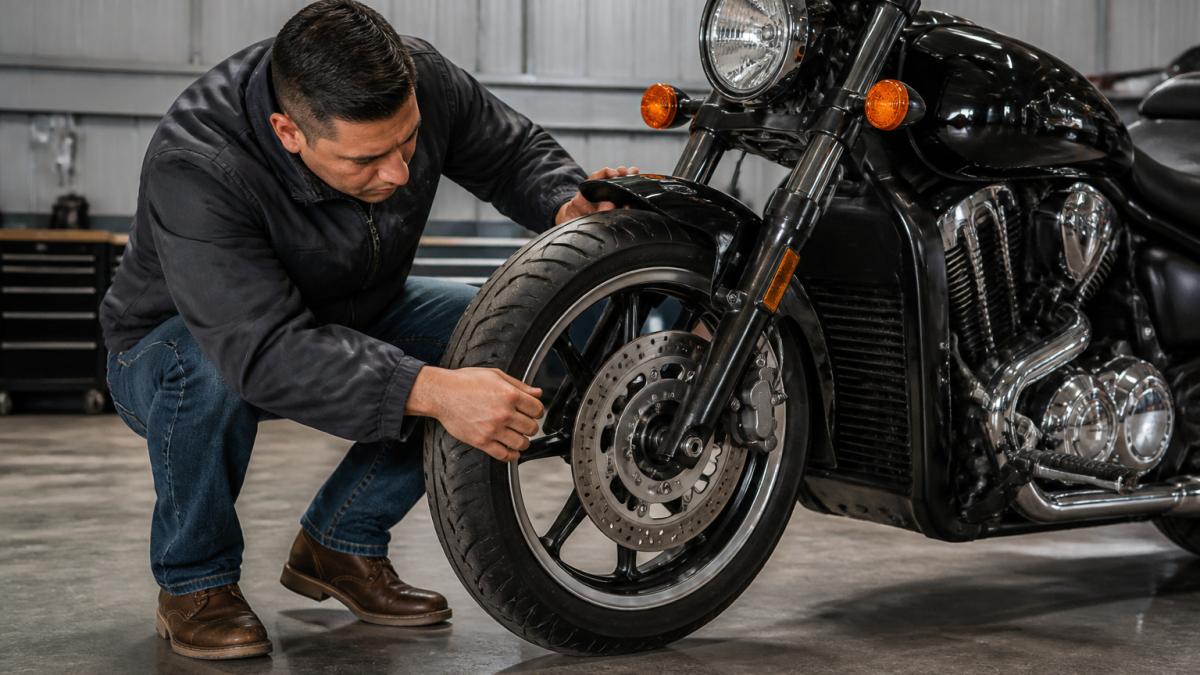
A buyer in a casual jacket examining the tires and brake pads of a used cruiser motorcycle in a bright service bay
- Tires: Check tread depth and look for cracks in the sidewall. Tires age out even when tread looks deep; a date code older than about five to six years is a replacement candidate regardless of miles.
- Brakes: Test the front and rear brakes during the test ride. Look at pad thickness and fluid condition. Brake fluid absorbs moisture over time, so a bike that sat may need a flush even with low miles.
- Fluids and leaks: Inspect the engine, transmission and final drive for oil or coolant leaks. Check that fluid levels and colors look normal. Coolant and brake fluid degrade with age, not just use.
- Battery and electrical: Confirm that lights, the horn, signals and gauges work. A weak battery is common on bikes that sit, and a battery that has been deeply discharged may need replacement.
- Fuel system: Look for stale fuel smells or varnish in the tank, and ask when the fuel was last changed. Ethanol-blended fuel left standing can gum injectors and fuel lines.
- Chain or belt and sprockets: Check adjustment, wear and lubrication. A belt that sat under tension for years can develop flat spots or cracks.
- Frame and bodywork: Look for signs of accident repair, mismatched paint and bent components.
- Cold start: Ask the seller to let the engine start from cold. Listen for unusual noises and watch the exhaust. A bike that starts cleanly from cold after sitting is a better sign than one that was warmed up before you arrived.
- Storage signs: Look for rust in the tank, corrosion on fasteners, a musty smell under the seat, and rodent damage to wiring or airbox foam. These are common on bikes stored in sheds or garages for long periods.
- Suspension and seals: Check fork tubes for pitting and oil film, and look at shock bodies for leaks. Seals can dry and crack during long storage.
Watch out: A bike that has been sitting can look perfect and still need work. Ask for a start-up, a short ride, and a close look at the fluids before you commit. Budget for a baseline service, fluids, battery, tires if aged, even on a low-mileage bike that passes inspection.
Watch OutLow mileage is not the same as low risk. A bike that sat for two years may need more immediate attention than one that was ridden regularly and serviced on schedule. Treat the odometer as a starting point, not a verdict.
Reviewing Used Motorcycle Maintenance Records and Service History
Service records are often the strongest evidence of how a bike was treated. Ask for receipts, a maintenance log or a dealer service history. Records that show regular oil changes, valve checks where applicable, and brake and tire work are good signs.
Look for consistency. Gaps in service during long periods of ownership can be a red flag, especially if the odometer shows steady use. Also check whether recommended services were completed at intervals the manufacturer specifies, and confirm the bike’s VIN matches the paperwork.
If the seller has no records, that is not automatically a deal-breaker, but it raises the importance of a professional inspection. Factor the cost of catching up on maintenance into your offer.
Indian Motorcycle Models for New Riders to Consider Used
New riders often do best with a model that is manageable in weight, has predictable power delivery and is easy to ride at low speeds. Test several models before deciding, because seat height, reach to the controls and weight all affect confidence.
Pre-owned bikes can offer more value for a first motorcycle, but a used bike that is too powerful or heavy can be harder to learn on. Choose a model suited to your current skill, and plan to upgrade later if you want more performance. Prices depend on model year, condition and listing details, so ask the dealership for a current quote.
Booking a Pre-Purchase Inspection and Test Ride
Schedule a test ride before any purchase, and treat it as a structured evaluation rather than a quick spin around the block. Ride at low speeds to check clutch feel, then on a route that includes stops, turns and a short highway section if possible. Note how the brakes respond, how smoothly the transmission shifts and whether the bike tracks straight.
For a used bike, ask for a pre-purchase inspection by a qualified technician. A qualified technician can check items a casual buyer may miss, such as compression, electrical load and signs of prior crashes. Keep any inspection report with your paperwork.
At Indian Motorcycle of Ventura County, our team can help you think through the inspection points above and arrange a test ride. For current pricing or a quote on a pre-owned machine, contact the dealership directly, since prices depend on the bike, its condition and current availability. Schedule a Test Ride to see how a low-mileage Indian suits your riding.
Frequently Asked Questions
What is considered low mileage for a used motorcycle?
There is no single universal threshold. Mileage should be judged against the bike’s model year and how it has been used. A motorcycle with modest miles for its age is generally considered low mileage, but a bike that sat unridden for long periods can carry storage-related wear even with few miles on the odometer. Compare the odometer reading to the bike’s age, then check service records to see whether the miles were ridden regularly and maintained on schedule.
Are low-mileage used motorcycles a good buy?
They can be, but low mileage is only one factor. Maintenance, storage, and age also matter when evaluating a low-mileage used motorcycle. Treat low mileage as a reason to inspect more closely, not as proof of a good purchase.
What should I check when buying a used Indian motorcycle?
Start with a full inspection covering tires, brakes, chain or belt, fluid condition, leaks, electrical systems, and signs of accident damage. Ask for maintenance records and confirm that oil changes and inspections were completed on schedule. Test ride the bike to check shifting, braking, and any unusual noises. Bring a checklist so you compare each bike on the same criteria.
What questions should I ask before buying a pre-owned Indian motorcycle?
Ask how the bike was used and stored, whether it was ever in a crash, and whether all recalls and scheduled services were completed. Ask what inspection or warranty the seller provides on used units. Request service receipts and check whether the bike has a clean title. Clear answers in writing are a good sign that the seller is willing to back up the listing.


